Look up the definition of "problem" in the Oxford English Dictionary and you'll find: "a matter or situation regarded as unwelcome or harmful and needing to be dealt with and overcome." That's pretty clear. Now look up "decision" and you'll find something like: "a conclusion or resolution reached after consideration," or even better, "the action or process of deciding something."
So, we have crisp language for problems, but vague language for decisions. I find this interesting because a problem is basically a description of a situation while a decision is a solution to a problem. In other words, while problem definition matters, it's not the main event. What ultimately counts is the solution. I only bring this up because when you look at most so-called "decision frameworks," they tend to reflect that bias. They're really better at helping us frame problems than at guiding us through the act of deciding.
So let me offer a clearer definition: "A decision is a commitment to action, shaped by its consequences, the constraints on alternatives, and the anticipated future states of the world."
This isn't just semantics. When we can define a decision as the product of its components (constraints, consequences, and future states), we can begin to organize and plan for the choices our organization will face. We can allocate scarce resources — time, capital, and attention — to the decisions where they will have the greatest leverage.
Consequences capture the impact of the decision if it goes wrong — from trivial inconvenience to major financial or strategic risk exposure. Constraints describe how many real options we have — are our choices wide open, or tightly limited? While both consequences and constraints are critical to the decision-making process, I submit that they are usually known, or at least easy to discover, and do not require much of an investment.
Forecasting the future state of the world, though, is very different. There are countless possible futures, each with its own probability. Which ones do we need to be concerned with? Which of these are most likely? How much more likely is one state than the others? How confident are we in our assessment? Often the answers are obvious and we can just act. Many more times, the answers are not obvious — but they are also not important. And then, of course, there are those few decisions that will require huge investments into figuring out what the future is most likely to look like….
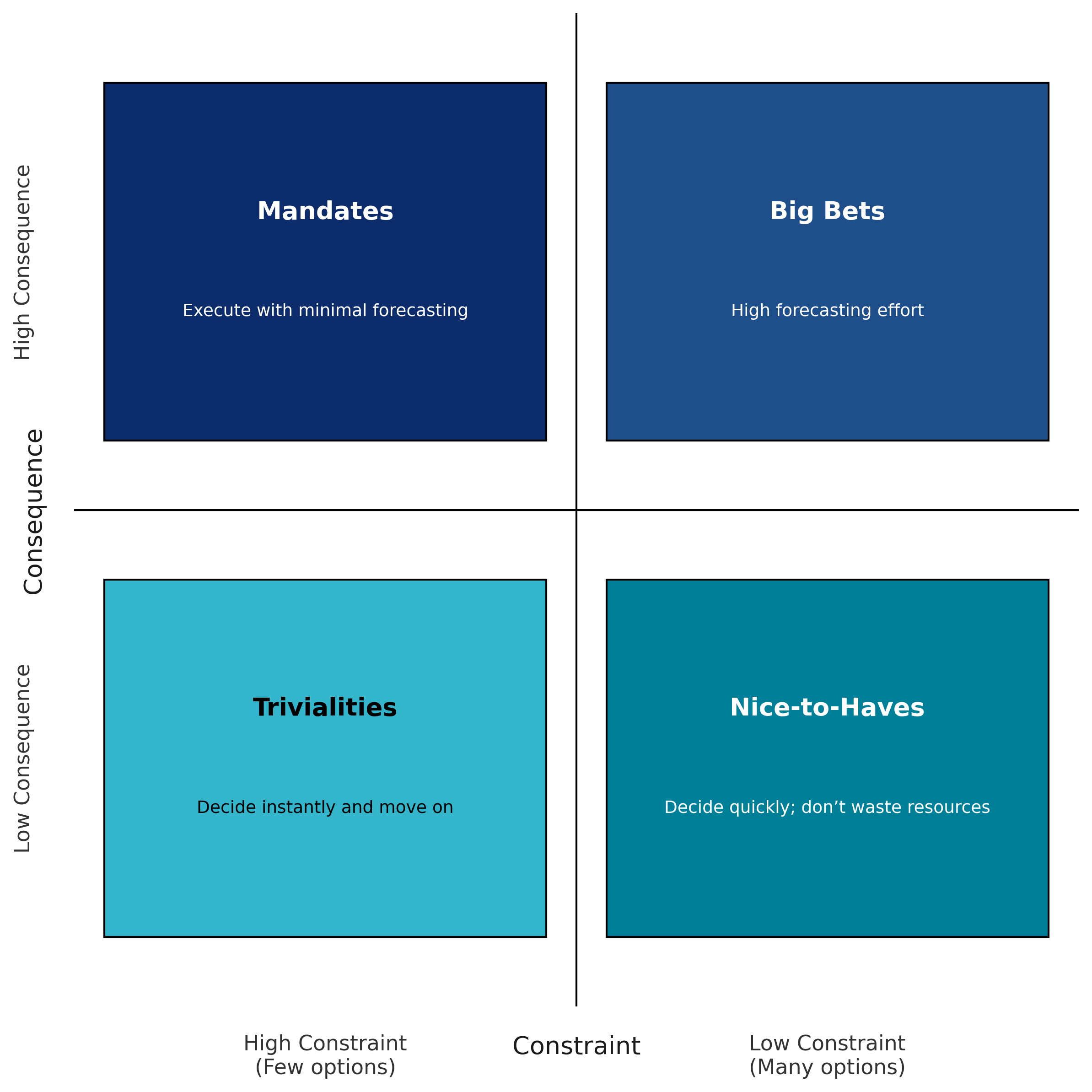
The problem most businesses face is distinguishing between the last two options: not obvious but not important and not obvious but really important. My solution is to look at decisions through the lenses of the two known or at least more knowable components — consequences and constraints. Put those two dimensions together and we can imagine a simple grid where each quadrant represents a different kind of decision:
| Quadrant | Example | Forecasting Effort |
|---|---|---|
| Mandates (high stakes, few options) | Responding to a new regulation that forces compliance within a set deadline. | Low effort — the outcome matters, but options are narrow; focus on execution, not analysis. |
| Big Bets (high stakes, many options) | Entering a new market: multiple viable entry strategies (partnerships, direct sales, acquisitions) with very different risk/reward profiles. | High effort — scenario modeling, probabilistic forecasts, and structured debate pay off here. |
| Trivialities (low stakes, few options) | Selecting which vendor to use from a pre-approved shortlist for office supplies. | No effort — trivial impact, narrow options; just choose and act. |
| Nice-to-Haves (low stakes, many options) | Choosing a new project management tool (Trello, Asana, Monday, etc.) for a small internal team. | Minimal effort — lots of options, but little strategic impact; pick one and move on. |
The ultimate point here is that we often treat every decision as if it were complicated (the dreaded analysis paralysis) because it is often hard to distinguish between those that are and those that are not. I'm offering a way to calibrate the forecasting effort so that we can skip it when the choice is obvious or unimportant, and invest heavily when both the stakes and the options are wide.
Of course, this leaves us with a couple of big questions.
First, how much should you spend attempting to forecast high-consequence, low-constraint decisions? The grid tells us where to focus effort, but not how much is enough.
Second, how can we know the future? Can we really forecast it — especially in cases where we do not have large sets of structured data to guide us?
Those are topics I'll take up in future posts. For now, the takeaway is simple: forecasting is the scarce resource in decision-making — and knowing when to spend it is the first step toward better choices.
← Back to Writing