
Challenge
Increasingly, private equity firms are evaluating acquisition targets based on revenue growth potential. Placing a value on the sales funnel is an important yet difficult part of the due diligence process. The standard solution for this has always been the expected value method (also called the weighted pipeline), where the probability of closing for each funnel stage is multiplied by the value of the deals in that stage, then summed to a total. Our client recognized three problems with this approach:
- Probabilities of closing are only estimates — and often very broad estimates. This is particularly true in the early stages of the sales funnel.
- Deal values are very often inflated. Sales representatives are evaluated on the size of their funnel, so they often assume the most optimistic scenario until more specific information is attained.
- Most importantly, the expected value method interprets the probability of closing as the percentage of each deal that will be attained rather than the percentage of deals that will close. As an example, if there are four opportunities valued at $1,000, $10,000, $100,000, and $1M, then 25% of those dollars is around $275,000. If, however, only 1 in 4 of those deals close, the stage could be worth between $1,000 and $1M.
Our client recognizes these issues but does not have the capacity to independently examine and evaluate each opportunity in a sales funnel that might include hundreds of deals. Instead, they rely on appraising broader aspects of a target's revenue generation potential. These might include the capabilities and tenure of sales management, management's forecasting methods, sales representative turnover, funnel growth rates, etc. Their request was for a method to quantify their impressions and express their confidence in the resulting funnel values while also making the process transparent and repeatable.
Solution
Our solution was an application that allowed members of the due diligence team to manipulate "confidence dials." In the simple example below (our actual solution included several more dials used to fine-tune assumptions), we use input from the dials as parameters for functions that tighten confidence intervals as funnel stages progress. Less confidence equals wider intervals and more variance in stage percentages and deal size. Users can assess their input levels by observing changes in the "noise charts." The final output includes the 75% probability value, the 90% value, and the percent probability of attaining or exceeding management's guidance. (Management's guidance was based on the expected value method of forecasting.)
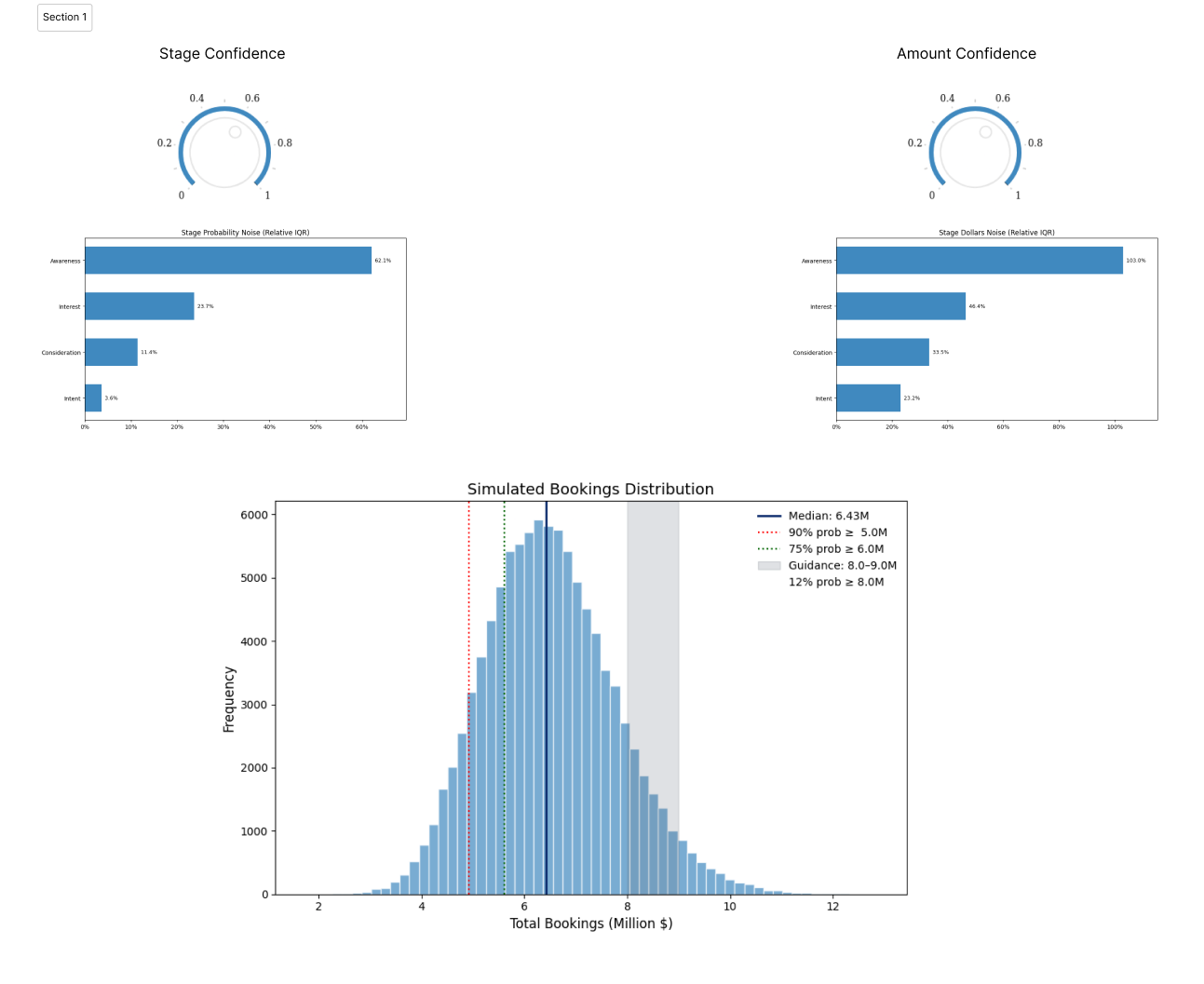
Using this tool, due diligence committee members are able to engage management in a structured conversation about assumptions, risk, and upside. Both sides can work from the same set of quantified scenarios to fine-tune a funnel valuation and the confidence behind it. The result is a more transparent diligence process and more defensible deal terms.
Technical
To simulate uncertainty in stage win rates, the application draws from a Beta distribution by sampling one probability per stage across 100,000 simulations. The width of this distribution is controlled by a concentration factor that determines how tightly outcomes cluster around sales management's probabilities. The assumption that estimated close ratios get more accurate as opportunities progress is modeled using a variance function that decreases uncertainty with stage probability. The Stage Confidence knob controls the overall concentration level.
To account for the idea that a deal's total value will be won or lost (not some percentage of it), each sampled probability is used in a Bernoulli (coin-flip) draw to determine whether the deal closes.
Uncertainty around deal values is simulated by applying a multiplier that increases or decreases a deal's size. This multiplier is generated by drawing from a skew-normal in log space, scaling by a per-deal log-volatility that decreases linearly with stage, and then exponentiating to keep values positive. Deal value optimism is counteracted with a negative skew. The final simulated deal values are the product of the original deal sizes and these multipliers. Inputs into the construction of these multipliers are provided by the Deal Size Confidence knob.
Total funnel value is the summed product of each draw's Bernoulli outcome and estimated deal value.
← Back to Writing